





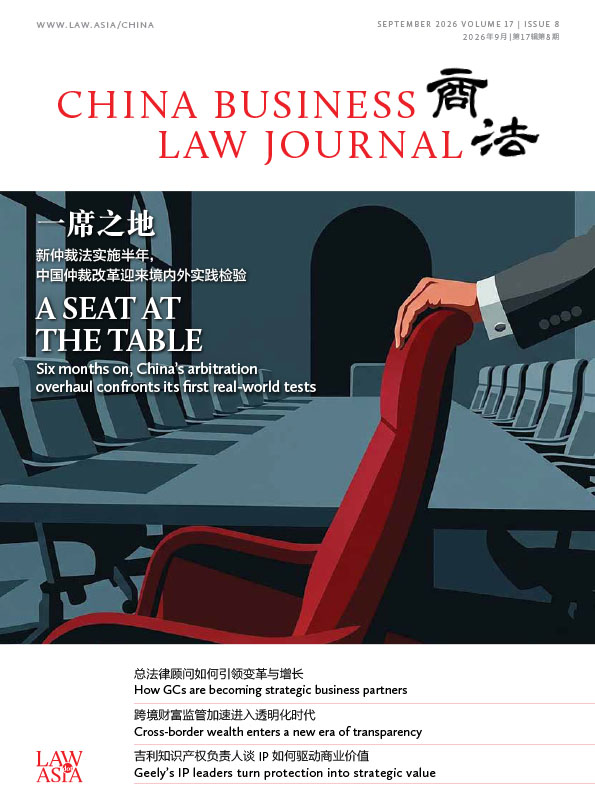


China Business Law Journal – September 2026
Volume 17, Issue 8
Subscribe now to read China Business Law Journal in full and unlock our full archive and a vast resource of legal intelligence.
Highlights:
- A seat at the table: Six months on, China’s arbitration overhaul confronts its first real-world tests
- How GCs are becoming strategic business partners
- Cross-border wealth enters a new era of transparency
- Geely’s IP leaders turn protection into strategic value
- Lexicon: History, law and international relations
In touch with reality?
Rules provide certainty, but their real significance emerges only when they meet commercial reality. Six months after China implemented its most substantial arbitration overhaul in three decades, our cover story, A seat at the table, examines that development.
The revised Arbitration Law introduces ambitious changes intended to strengthen China’s position in international dispute resolution, but practical challenges are already surfacing. From ad hoc arbitration and the formal recognition of the arbitral seat to the compression of the set-aside application window from six months to three months, the reform asks parties, counsel and institutions to reconsider familiar strategies, to ensure its moving parts can function coherently at home and command confidence abroad.
That tension between rules and reality extends well beyond arbitration. In Rethink, recalibrate, remain, general counsel and legal chiefs discuss how tighter regulation, global compliance pressures and AI-driven transformation are changing the corporate legal function. In-house counsel are no longer expected merely to contain risk. Increasingly, they must help shape strategy, guide cross-border growth and turn legal technology into better business decisions.
As legal teams expand their strategic remit, transparency is also narrowing the room for ambiguity in private wealth. Offshore, not off the hook explores how CRS 2.0 and China’s new offshore trust tax rules are intensifying scrutiny of cross-border structures. Senior private wealth experts explain why disclosure, compliance and long-term planning are replacing opacity as the foundations of sustainable wealth management.
Compliance alone cannot protect a company from all forms of risk, and Court of public opinion considers why legally valid brand enforcement can still provoke public backlash. Drawing on disputes involving Louis Vuitton, Huawei and Xiao Noodles, practitioners show that the right legal action may become the wrong business decision unless litigation strategy is tested against reputational consequences.
The same need to align legal rights with commercial purpose is reshaping intellectual property (IP). Written by Geely Holding Group’s IP leaders, Innovation shifts gears examines how AI, geopolitical competition and global expansion are turning IP from a legal cost centre into a strategic asset. The machinery is changing, but the destination remains constant: protecting innovation and creating value.
That principle becomes more urgent when technology begins exercising judgment itself. This issue launches AI Convergence, a new series jointly presented by China Business Law Journal, the International Corporate Counsel Association and Aivigate to bring legal practice, technological insight and scientific thinking into closer dialogue. In its inaugural article, Who owns AI’s judgment?, legal AI strategist Cao Haiyang and veteran AI scientist Xie Dong argue that AI governance must focus on tasks rather than tools as systems move from answering questions to performing substantive legal work.
In this issue

Former CMS Beijing head joins Clifford Chance in Hong Kong
Clifford Chance hires Jonathan Chu as a partner at its Hong Kong office and head of intellectual property for the Asia-Pacific

Unfair competition in AI agent commerce
As AI recommendations and agentic procurement reshape market entry, GEO tests compliance, brand visibility, and fair competition

Hong Kong eyes role as regional intellectual property hub
Hong Kong lawyers examine the opportunities and challenges facing the city’s ambition to become a regional intellectual property trading centre