





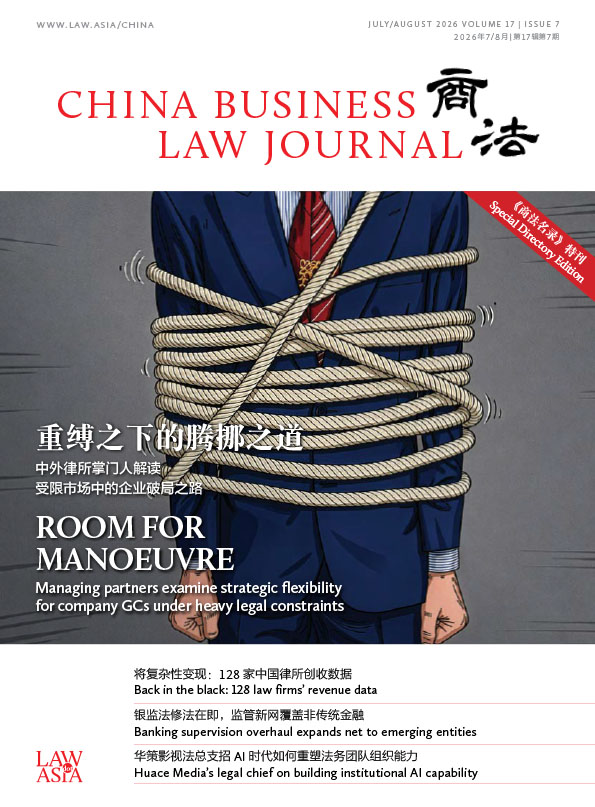


China Business Law Journal – July/August 2026
Volume 17, Issue 7
Subscribe now to read China Business Law Journal in full and unlock our full archive and a vast resource of legal intelligence.
Highlights:
- Room for manoeuvre: Managing partners examine strategic flexibility for company GCs under heavy legal constraints
- Back in the black: 128 law firms’ revenue data
- Banking supervision overhaul expands net to emerging entities
- Huace Media’s legal chief on building institutional AI capability
- Lexicon: Employment contracts and non-compete clauses
Rewriting the playbook
Doing business has entered an era of uncompromising calculus. Between intense domestic price competition, stringent data sovereignty enforcement and the regulatory hurdles facing outbound expansion, corporate leaders – both domestic champions and foreign multinationals – are operating under a fundamentally altered rulebook. Compliance is no longer a downstream checkbox; it sits firmly at the drawing board of corporate strategy.
In this issue’s cover story, Room for manoeuvre, managing partners from leading Chinese and international law firms dissect how enterprise resilience is being redefined. As capital flows shift and standard templates fail, we reveal how nimble legal executives are carving out room to manoeuvre within a heavily constrained operating environment.
That strategic playbook is being rewritten nowhere faster than in the financial sector. In Bank statement, we analyse China’s upcoming overhaul of its foundational Banking Supervision Law. In conversation with general counsel at top investment banks and veteran banking lawyers, we examine an expanding regulatory net designed to sweep in non-traditional financial entities and set out how institutions can prepare before the new perimeter hardens.
If regulatory pressure is mounting, the legal practices absorbing the strain are at least beginning to see a commercial payoff. Glimmers of light analyses 128 Chinese law firms’ revenue data, alongside qualitative commentary from partners at another 28 legal shops, and offers a rare look at the sector’s financial underbelly. What emerges is an industry learning to monetise complexity, trading the easy deal velocity of the past for high-margin restructuring, regulatory defence and cross-border disputes.
However, inside legal departments, achieving stability demands an urgent response to tech disruption. As algorithms turn routine drafting and research into near instantaneous commodities, the benchmark of legal value is rapidly shifting from technical execution to strategic risk architecture. In Organisation trumps the individual, the head of legal affairs and internal control at Huace Media outlines four pillars for institutional capability in the artificial intelligence era, arguing that collective organisational strength is now the only durable defence.
Beyond private firms and technology, the state is resetting its own operational framework. Turning point examines China’s draft Law on State-Owned Assets and proposed revisions to the Law on State-Owned Assets of Enterprises. Moving away from a fragmented history of standalone enterprise holdings towards a unified statewide domain, this legislative overhaul will reshape public sector dealmaking and asset governance.
Navigating these systemic shifts ultimately comes down to assembling the right external brains trust. To help legal executives align corporate strategy with specialised capability, this issue concludes with our latest CBLJ PRC Law Firm Directory, a curated benchmark of the country’s premier practices, ensuring you have the right advisers at the table when old scripts no longer apply.
In this issue

Sunwell recruits two senior partners from Hiways in Shanghai
Shanghai-based boutique Sunwell Law Firm hires Wang Jin and Zhang Tao, both joining from Hiways, as senior partners

Where equitable subordination applies to shareholder loans
When shareholder loans mask undercapitalisation, Chinese courts apply equitable subordination in bankruptcy to protect ordinary creditors from severe abuse

Firms steer State Grid’s record USD2.22bn dim sum bonds
State Grid completes a landmark RMB14.9 billion (USD2.22 billion) issuance of dim sum bonds in Hong Kong


The AI data squeeze
PatSnap compliance chief on AI data compliance under dual US-China rules








Turning point
Senior practitioners break down key state asset law revisions, evaluating emerging legal risks in state-owned enterprise restructuring and asset transactions